Do your students forget new words quickly, even after lots of practice? Traditional memorization methods often don’t help students truly understand and use new vocabulary. They might recognize words in writing but struggle to say them in conversation, leading to frustration and low confidence in learning a language.

Total Physical Response (TPR) to the rescue!
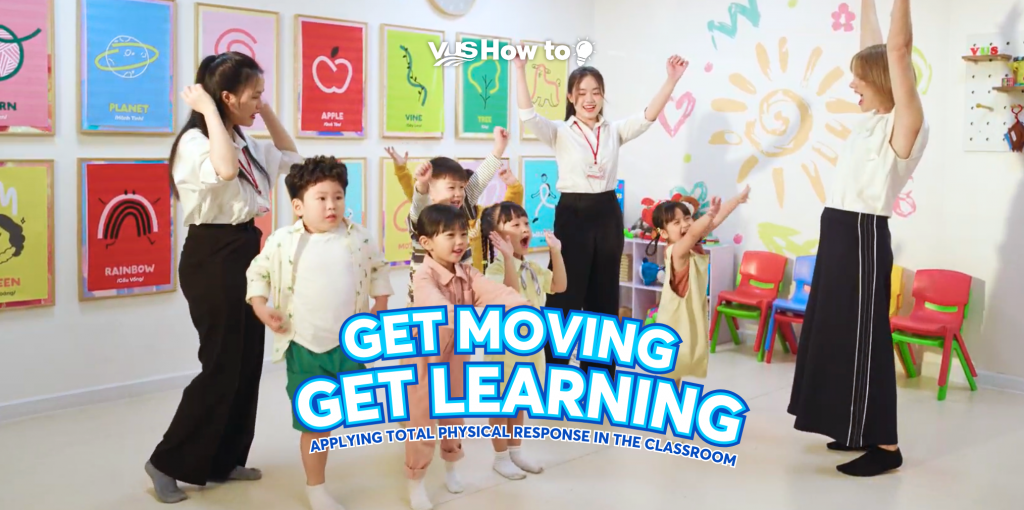
What if learning a new language could be more fun and hands-on? Total Physical Response (TPR) is a teaching method that turns passive learning into an active experience. Instead of just listening, students move and act out words, making it easier to understand and remember them. TPR uses movement to reinforce learning, helping students pick up new vocabulary naturally while having fun.

1. Suggested Activities Using TPR
1.1 Simon Says:
Step1 – Give Commands: Start with simple commands like “Jump,” “Turn around,” or “Touch your nose.”
Step 2 – Add “Simon Says”: Prefix some commands with “Simon Says,” and others without.
Step 3 – Students Respond: Students perform actions when “Simon Says” is used.
This classic game enhances listening comprehension and quick reaction skills. It’s a fun way to reinforce vocabulary and get students physically active.
1.2 Scavenger Hunt Challenge:
Step 1 – Prepare Items: Gather or list the items to be found (e.g., “something blue,” “a book,” “a pencil”).
Step 2 – Give Instructions: Tell students what to find and set a time limit.
Step 3 – Students Search: Students search for the items and bring them to you.
Scavenger hunts combine physical activity with vocabulary practice in a dynamic and engaging way. Students learn to understand and respond to instructions while searching for specific items.
1.3 TPR Storytelling Session:
Step 1 – Tell Story: Tell a story using exaggerated gestures and actions.
Step 2 – Repeat & Emphasize: Repeat key phrases and actions.
Step 3 – Students Participate: Encourage students to join in with the actions.
TPR storytelling makes language learning memorable and enjoyable. The combination of narrative and physical movement helps students understand and retain new vocabulary in context.
1.4 TPR Activity for Adults: Role-Playing Scenarios:
Step 1 – Set Up Scenario: Describe a real-life situation (e.g., ordering food, asking for directions).
Step 2 – Assign Roles: Assign roles to students (e.g., customer, waiter, passerby).
Step 3 – Act Out: Students act out the scenario, using TPR to respond.
Role-playing with TPR makes language learning practical and relevant for adults. It helps them build confidence in using the language in everyday situations.
2.1 Why TPR is one of the well-known choices
2.2 Don’t make these mistakes!
Conclusion
TPR is a dynamic and effective tool for language teaching, making vocabulary acquisition more engaging and intuitive. While it may not suit every student or lesson, incorporating TPR into your teaching toolkit can enhance comprehension, retention, and classroom interaction. Give it a try and see how movement can transform your lessons!
With nearly 30 years of experience in English education in Vietnam, VUS has grown its network to 73 campuses and more than 2,700 qualified teaching staff nationwide.
VUS is proud to be recognized with two awards at the Vietnam Technology Excellence Awards 2025, honored as an Inspirational Brand at APEA for two consecutive years, and acknowledged through various national and international awards.
When joining VUS, teachers and teaching assistants enjoy a wide range of practical benefits that support long-term growth and commitment:
- Stable income: Steady and fair rewards for your efforts, allowing you to focus on teaching and growth.
- Ongoing professional training: Structured onboarding with entrance workshops and continuous support via sharing sessions and the Training Hub, led by Teaching Quality Managers holding master’s or doctoral degrees and extensive teaching experience.
- Modern, international-standard facilities: Diverse teaching tools, updated materials, and well equipped classrooms for a professional working environment.
- Engaging internal events: Activities that create opportunities to relax, connect with colleagues, and recharge your energy.
- Supportive colleagues: Work with a team that is always ready to share, support, and grow together.
- Clear career advancement: A transparent career path with many opportunities to challenge yourself and grow into higher roles.
VUS offers a professional workplace where you can strengthen your skills, grow your career, and inspire young learners across Vietnam:
– Expatriate Teachers: Experience teaching in Vietnam with international standards, integration support, and career development opportunities.
– Vietnamese Teachers: Continuously sharpen your expertise while helping students reach out to the world.
– Teaching Assistants: The first step to explore the teaching profession and gain valuable real-life classroom experience.
Start your teaching journey with VUS today!