
Every ESL teacher has experienced it: you finish your lesson five minutes early, your planned activity falls flat, or your students just aren’t getting the language point and you need to pivot immediately. While carefully planned lessons are always the goal, having a handful of reliable, no-prep activities can make classroom life much easier.
The best no-prep activities aren’t simply “time fillers.” They reinforce vocabulary and grammar, encourage students to communicate, and provide valuable practice – all while requiring little more than what’s already in your classroom. Having these activities in your back pocket can help you get you out in a pinch, and as you use them more you’ll be able to quickly adapt them to the situation at hand.

Here are ten activities that are easy to set up and flexible enough to use across a wide range of ages and proficiency levels.
Table of Contents
Mini Whiteboard Activities
Mini whiteboards are one of the most versatile classroom tools, and some of the simplest activities are also some of the most effective. It’s never a bad idea to have some of these on hand for any lesson, and you can find a big stack of them in any VUS teacher room. For small classes, each student can have their own miniboard; for larger classes, divide them into teams and give each team a miniboard. For team activities, be sure the teams actively rotate their ‘writer’ so it’s not just the strongest students participating every time.
1. Draw It!
Best for: Vocabulary review
Act out a vocabulary word and ask students to write it as quickly as they can. Once everyone is finished, have students hold up their boards at the same time. This works especially well with concrete nouns, actions, adjectives, and even simple prepositions.
You can use more complex vocal descriptions for stronger classes, adding an extra layer of listening practice. Alternatively, you can invite students to take turns acting out the vocabulary instead of the teacher. You can also ask students to say the target language out loud, adding an extra speaking element.

Because everyone reveals their writing simultaneously, every student participates, not just the fastest volunteers.
2. Race to Write
Best for: Grammar and sentence construction
Rather than asking students to answer orally one at a time, have everyone write their answer on a mini whiteboard.
Your prompt can be as simple or as challenging as needed:
⭐ Write a sentence using today’s grammar.
⭐ Write three foods beginning with different letters.
⭐ Write a question you could ask your partner.
⭐ Correct this sentence.
Students race to finish before holding up their answers together. The activity naturally encourages accuracy as well as speed, and because everyone answers at once, you can quickly identify common mistakes across the class.
3. Secret Answer
Best for: Speaking and reviewing lesson content
Ask students a question but have them keep their answer hidden until everyone is ready.
For example:
⭐ Which animal is the most dangerous?
⭐ Which holiday is your favourite?
⭐ What word completes this sentence?


Once every student has written an answer, everyone reveals their boards together. Students then explain or defend their choices with a partner or the whole class.
The simultaneous reveal prevents students from copying each other and encourages everyone to think independently before discussing their ideas.
Activities Using Classroom Realia
Many classrooms or teacher rooms already contain simple teaching tools like dice, flashcards, or soft balls. These familiar items can easily be used to create engaging review activities. VUS teacher rooms are well-stocked with these items and more, so it’s easy to grab a basket and fill it up as needed.
4. Roll & Respond
Best for: Speaking practice and lesson review
Divide the class into teams and assign a different vocabulary word to each number on a large die. For example, if the unit is on chores:
1: Wash the dishes.
2: Take out the garbage.
3: Water the plants.
4: Make my bed.
5: Sweep the floor.
6: Feed the dog.

A student from Team 1 will stand up and roll the die, and then use the corresponding vocabulary word in the related grammar point from the unit. For example, if the student rolls a 3: “I water the plants on Monday.” The student then gets 3 points after correctly answering. You can add a layer of fun by having the student move a character 3 spaces forward on a game board.
With enough practice your students will eventually be able to manage the gameplay on their own. This activity is easily adaptable to new units, and changing the numbered items regularly keeps the activity fresh while allowing you to review almost any language point.
5. Fly Swatter Challenge
Best for: Vocabulary revision
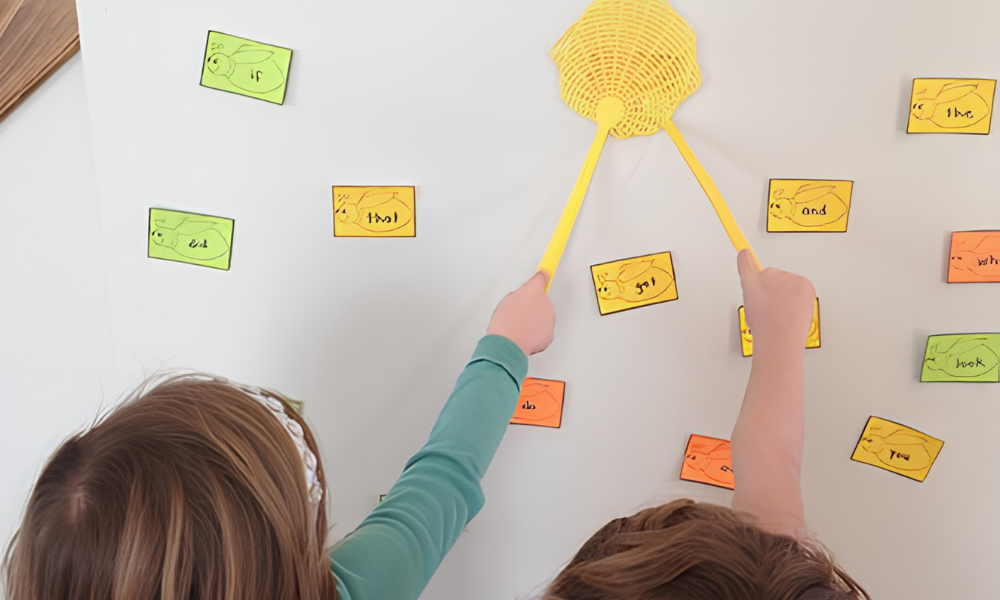
Attach vocabulary flashcards around the whiteboard. Divide the class into two teams and give one fly swatter to a representative from each team. Call out a vocabulary word and finish with ‘go!’ Students then race to slap the correct flashcard with their flyswatter. It’s always a good idea to model correct racing and swatting techniques to avoid broken class items or broken students!
For more advanced students, instead of simply calling out the vocabulary word, increase the challenge by giving a definition, example sentence, or synonym. The first student to swat the correct card earns a point.
As students become more confident, invite them to give the clues instead of the teacher. This shifts the focus from simple recognition to actively producing language. The fast pace and friendly competition make this a favourite review activity for younger learners. At VUS, vocabulary lessons have their own slide deck, so you can easily display all of the words without needing to tape cards to the board.
6. Pass the Ball/Hot Potato
Best for : Speaking fluency
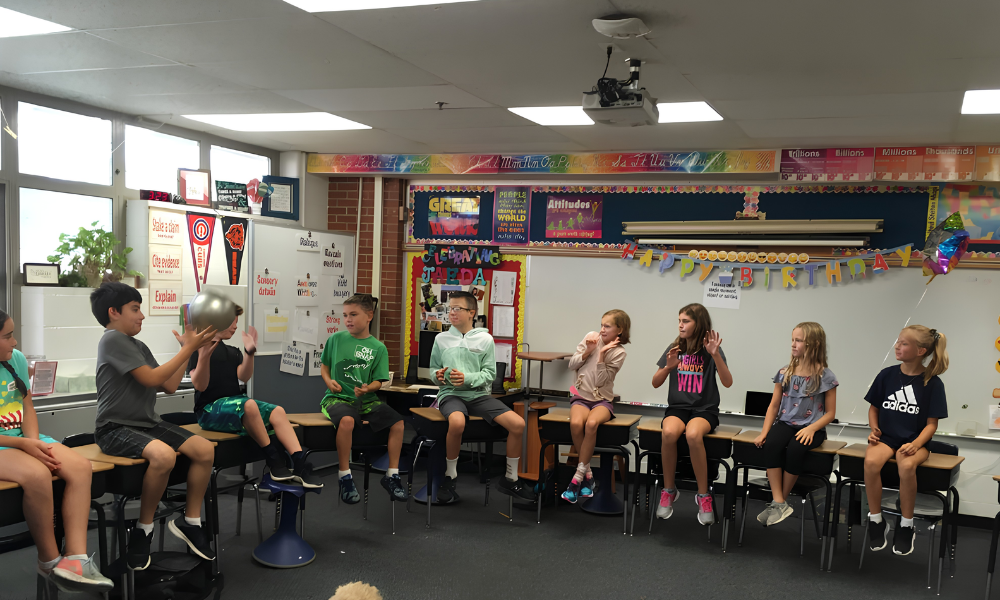
Students pass a soft ball around the classroom while counting or while music plays. When the teacher calls “Stop!” the student holding the ball completes a speaking task.
The prompt might be:
⭐ Answer a question.
⭐ Make a sentence.
⭐ Continue a story.
⭐ Describe a vocabulary word without saying it.
⭐ Ask another student a question.
Because students never know when they’ll be chosen, everyone stays engaged throughout the activity.
Activities with No Props
Sometimes the best activities require nothing except your students and a little imagination (because you forgot to bring any extra items with you from the teacher room!).
7. Last Student Standing
Best for: Quick review and lesson warm-ups
Ask students to stand. Fire rapid review questions around the room, covering vocabulary, grammar, pronunciation, or general knowledge from recent lessons. Students who answer correctly remain standing, while incorrect answers sit down. Continue until one student remains.
If you prefer to avoid elimination games, simply keep score by teams instead. The teams can line up facing the board, with the front students competing and then going to the back of the line. The pace remains quick while ensuring every student continues participating until the end.

8. The Odd One Out
Best for: Vocabulary and critical thinking
Give students three or four words and ask them to identify the odd one out. For example: mango – banana – carrot – orange.
Students then tell you which one is different, and why. The interesting part is that there doesn’t always need to be one correct answer. Students can justify different choices, offering opportunities for creative thinking.
“Carrot is the odd one out because it’s a vegetable.”
“Banana is the odd one out because it’s yellow.”
This makes a simple vocabulary activity into a speaking and reasoning exercise.
9. Categories
Best for: Vocabulary retrieval
Choose a broad category such as food, transport, sports, jobs, or animals. Students take turns naming one item from the category, with no repeats allowed. As the list grows, students need to think more carefully, making the activity progressively more challenging; repeat a word on accident and get eliminated! To increase the difficulty, introduce a time limit or require students to use each word in a complete sentence before earning the point.
This simple retrieval practice helps strengthen vocabulary recall far more effectively than simply rereading a word list. It also allows your advanced students to flex their mental muscles with more creative answers.

10. Word Association
Best for: Vocabulary review and fluency
Have your students line up in teams, with the front students competing for that round. Say a word from the lesson. A student responds with another word connected to it, and the next student continues the chain.

Teacher: “Beach.”
Student 1: “Sand.”
Student 2: “Hot.”
Student 3: “Summer.”
Student 4: “Holiday.”
Students can’t repeat a word used by a previous team; for fairness, start the next round with a different team. For a more controlled activity, require students to use the word in a sentence or explain the connection between their words.
Final Thoughts
No-prep activities aren’t about filling spare time—they’re about making the most of every minute in the classroom. Whether you have five minutes left at the end of a lesson or need a quick way to reinforce a language point, these activities help students retrieve vocabulary, practise grammar, and communicate confidently without requiring extensive preparation.
Rather than trying to remember dozens of games, build your own small toolkit of reliable favourites. After you’ve used them a few times, you’ll find yourself adapting them naturally to different classes, language points, and proficiency levels. The less time you spend preparing review activities, the more time you can spend focusing on what matters most: helping your students use English with confidence.
With nearly 30 years of experience in English education in Vietnam, VUS has grown its network to 73 campuses and more than 2,700 qualified teaching staff nationwide.
VUS is proud to be recognized with two awards at the Vietnam Technology Excellence Awards 2025, honored as an Inspirational Brand at APEA for two consecutive years, and acknowledged through various national and international awards.
When joining VUS, teachers and teaching assistants enjoy a wide range of practical benefits that support long-term growth and commitment:
- Stable income: Steady and fair rewards for your efforts, allowing you to focus on teaching and growth.
- Ongoing professional training: Structured onboarding with entrance workshops and continuous support via sharing sessions and the Training Hub, led by Teaching Quality Managers holding master’s or doctoral degrees and extensive teaching experience.
- Modern, international-standard facilities: Diverse teaching tools, updated materials, and well equipped classrooms for a professional working environment.
- Engaging internal events: Activities that create opportunities to relax, connect with colleagues, and recharge your energy.
- Supportive colleagues: Work with a team that is always ready to share, support, and grow together.
- Clear career advancement: A transparent career path with many opportunities to challenge yourself and grow into higher roles.
VUS offers a professional workplace where you can strengthen your skills, grow your career, and inspire young learners across Vietnam:
– Expatriate Teachers: Experience teaching in Vietnam with international standards, integration support, and career development opportunities.
– Vietnamese Teachers: Continuously sharpen your expertise while helping students reach out to the world.
– Teaching Assistants: The first step to explore the teaching profession and gain valuable real-life classroom experience.
Start your teaching journey with VUS today!